
 WELCOME
Articles in Being Designerly 141 all point to the same shift: AI is making execution cheaper, which means judgment matters more.
From cognitive offloading and burnout to compressed design cycles and AI-assisted experimentation, the message is consistent: the designers who thrive won’t just be the ones who use AI. They’ll be the ones who know when to question it, when to resist it, when to rest from it, and when to use it to explore something better.
That’s the real designerly edge.

 FEATURE
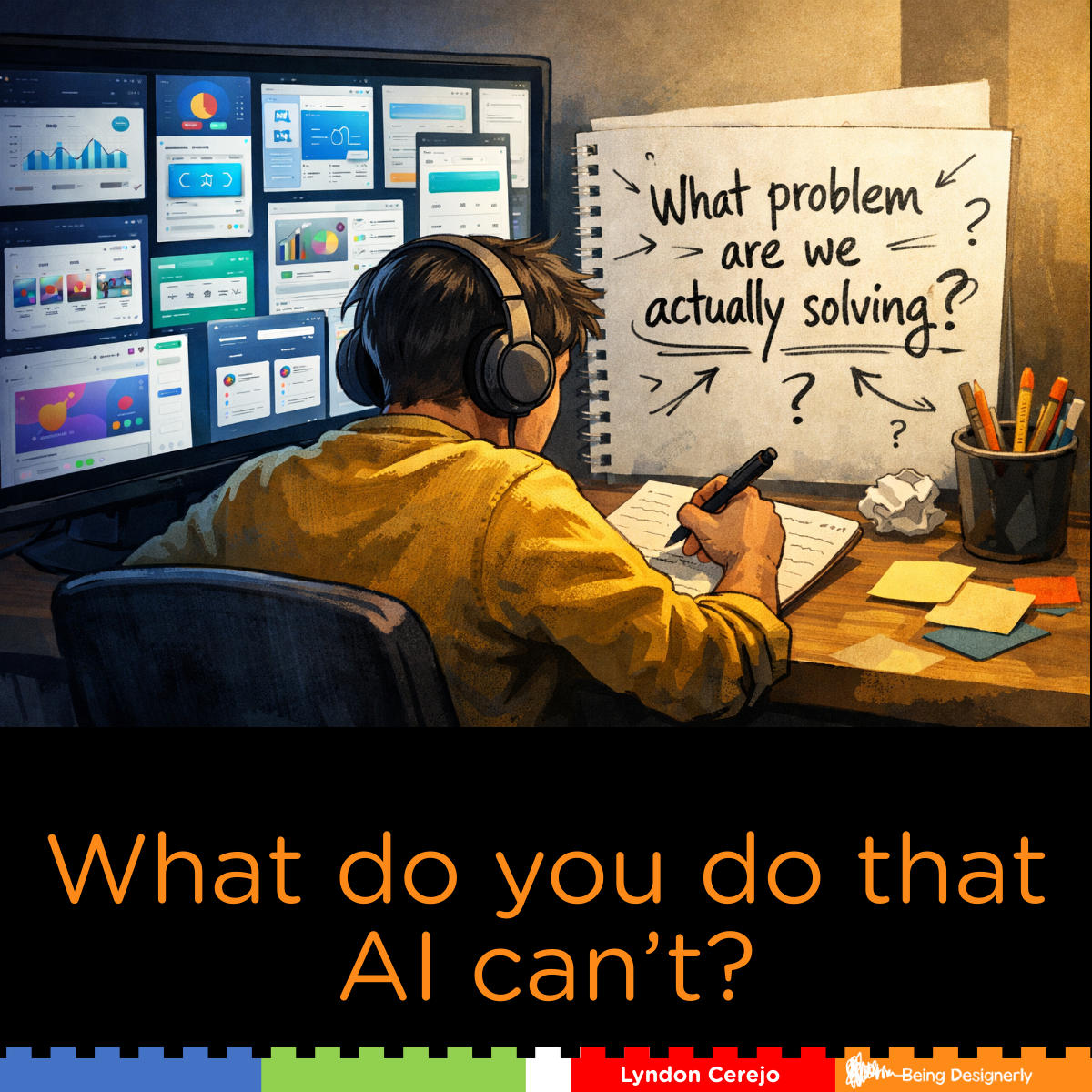
Designers: AI isn’t coming for your job.
Designers: AI isn’t coming for your job. But it is coming for your comfort zone.
For years, you could rely on:
- Craft as proof of value
- Deliverables as progress
- Polish as differentiation
Now? AI can do all of that. Faster.
Which means the question becomes: What do you do that AI can’t?
If the answer is “make screens”… that’s a problem.
If the answer is:
- “I challenge the problem itself” (Critical Thinking)
- “I explore what others overlook” (Curiosity)
- “I test ideas before they’re obvious” (Experimentation)
Now you’re playing a different game.
This isn’t a threat. It’s a forcing function.
To become the kind of designer we’ve always said we were.
 CURIOSITY
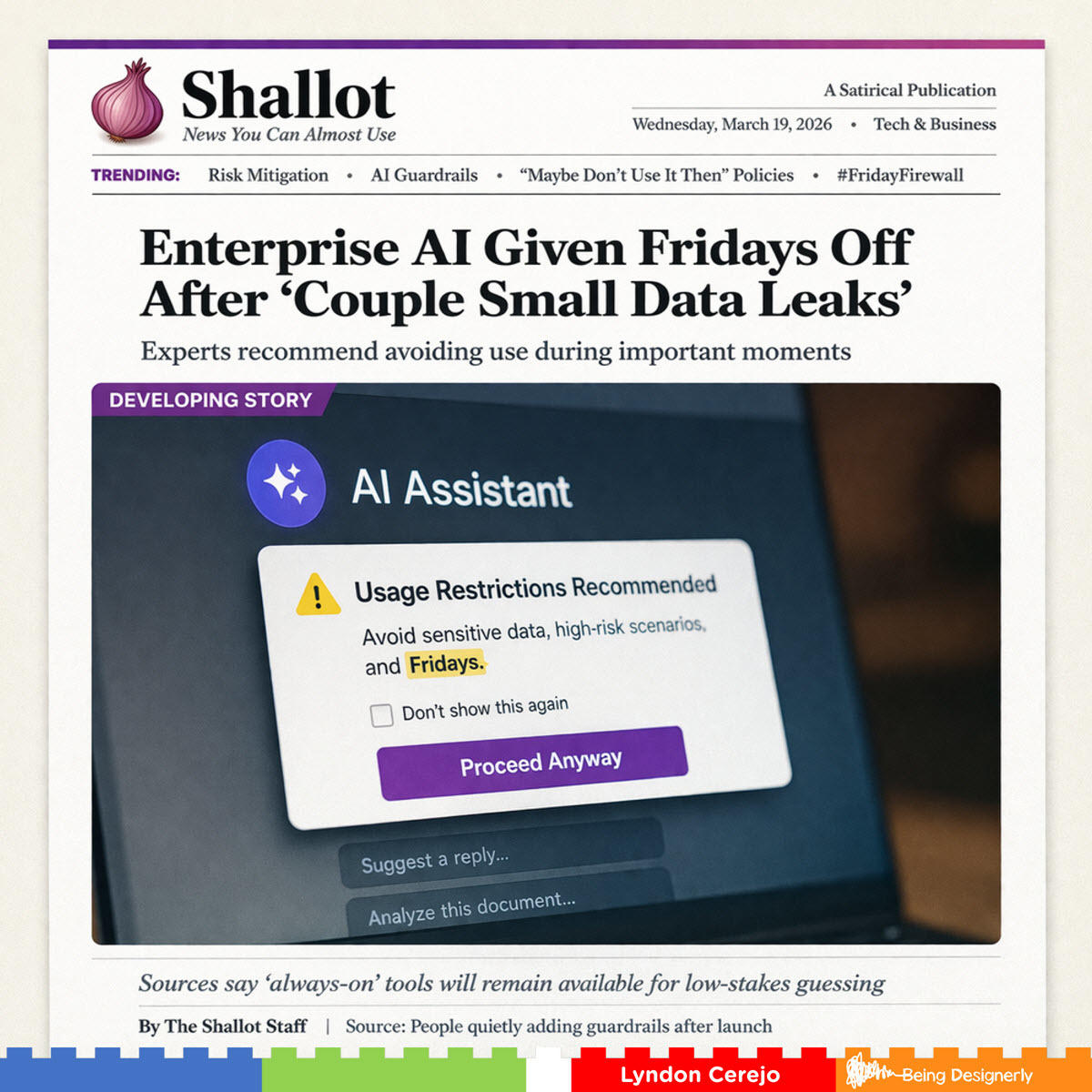
Enterprise AI Given Fridays Off After “Couple Small Data Leaks”
Satire alert: In a move described as “purely precautionary,” companies are now advising employees to avoid using AI copilots for sensitive work on Fridays. The decision follows several incidents in which the “always-on” assistant was, in fact, always-on… including when it absolutely shouldn’t have been.
linkedin.com
 CRITICAL THINKING

A writing professor’s new task in the age of AI: Teaching students when to struggle
When students use AI, they often can’t tell when they’re shortcutting their own thinking. A study published from late 2024 in the British Journal of Educational Technology found that students using ChatGPT improved their essay scores in the short term but showed no meaningful gains in knowledge. Moreover, they were prone to what the researchers called “metacognitive laziness,” meaning a dependence on the tool that undermined their ability to self-regulate and engage deeply in learning. This is a result of cognitive offloading.
theconversation.com
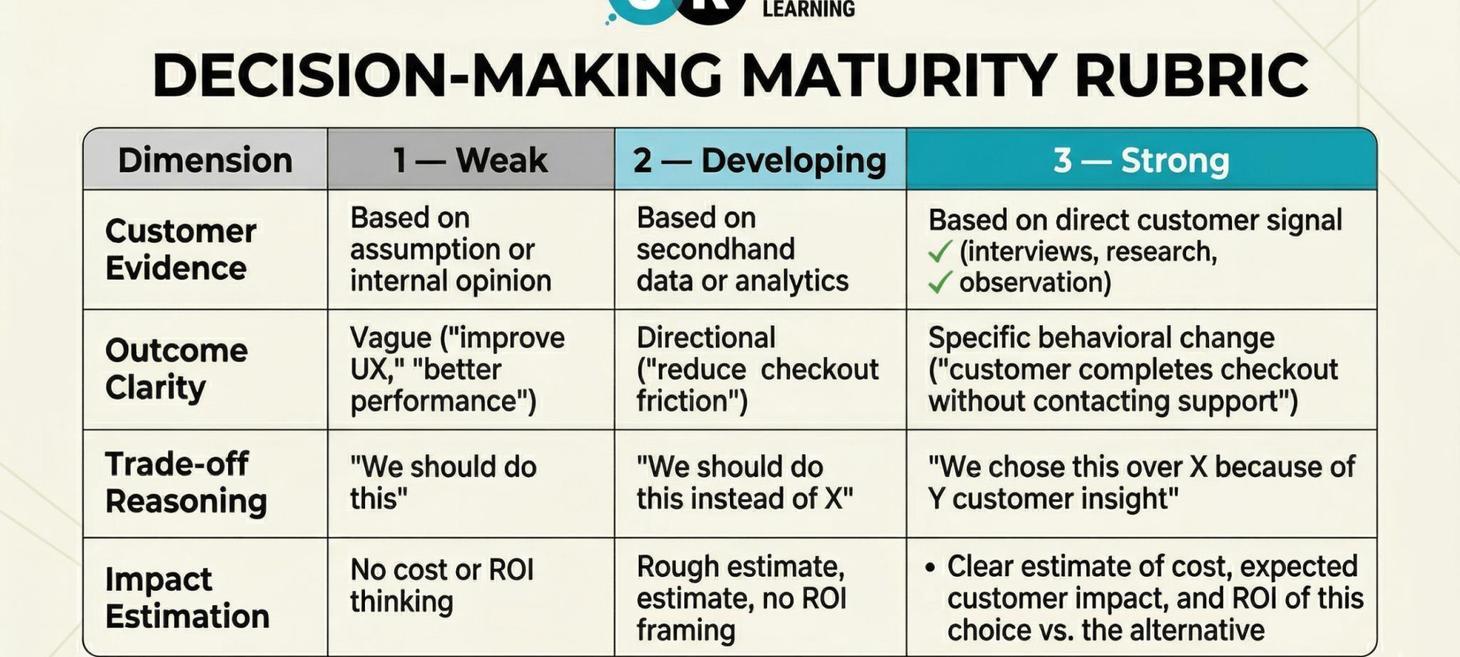
Four Ways to Measure Judgment.
Look for the kind of judgment that can explain itself, learn from outcomes, and improve over time. Your goal is to move away from “let’s just ship it and see what happens” to a deliberate, high-quality practice of expert decision-making.
jeffgothelf.com
 ADVOCACY

Social media trial: Meta and Google found negligent
A California jury found that Meta and Google were to blame for the depression and anxiety of a woman who compulsively used social media as a small child. This was the first time a jury has found that social media apps should be treated as defective products (deceptive design) for being engineered to exploit the developing brains of kids and teenagers.
This case put the spotlight on how social media services were designed: Meta's apps, including Instagram, and Google's YouTube, the jury concluded, were deliberately built to be addictive and the companies' executives knew this and failed to protect their youngest users.
npr.org

The AI Vampire Is Real, and I Have the Bite Marks
The AI Vampire isn’t a metaphor. It’s a measurable cognitive drain that scales with capability, and the people most at risk are the ones who are best at using AI. How Eric Porres, Logitech Chief AI Officer went from sleeping 78% to 70% in eight weeks. Advocate for yourself.
substack.com
 EXPERIMENT
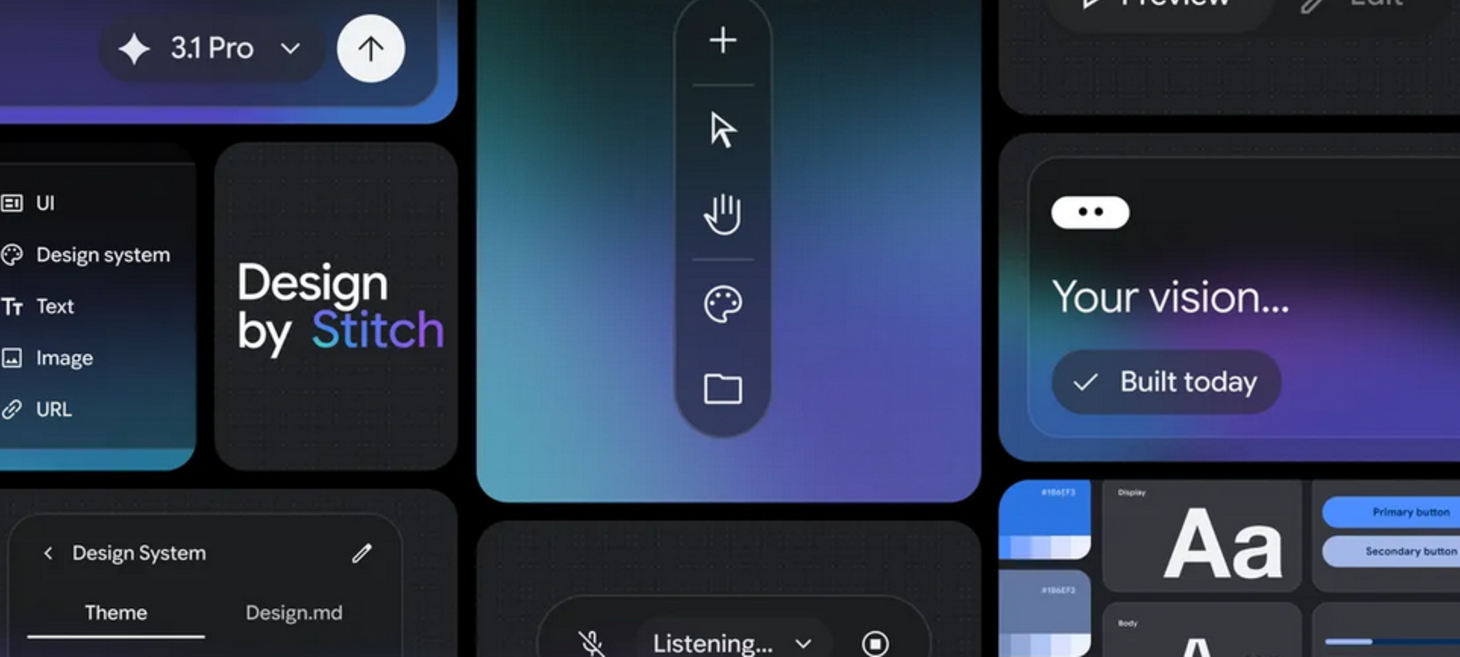
“Vibe design” with Stitch
Google's Stitch is an evolving AI-native software design canvas that enables anyone to create, iterate, and collaborate on high-fidelity UI designs using natural language. It features a redesigned infinite canvas, a new AI design agent for managing project evolution, enhanced design system tools, real-time interactive prototyping, voice command integration, and seamless export options for developers.
blog.google
Design Process Isn't Dead, It’s Compressed
There's a lot of discussion around the design process right now: throw out the process, trust your intuition, skip the research, and start building. As AI speeds up design work, the argument to "throw out the process" misrepresents how experienced designers work. Designers are experimenting on what that means for their work.
nngroup.com
