
 WELCOME

Sixth-anniversary Issue
While looking through the archives for this sixth-anniversary issue, I discovered something I'd completely forgotten.
My second issue of Being Designerly, published November 12, 2020, was largely about artificial intelligence.
This was before ChatGPT, AI agents, and the explosion of generative AI tools. The occasion was World Usability Day, whose theme that year was Human-Centered AI.
That issue included Google's People + AI Guidebook, Microsoft's guidelines for human-AI interaction, a GPT-3 bot that had been posting on Reddit without people realizing it wasn't human, and a Guardian article written by AI. I even joked that my newsletter was written using only the human variety of intelligence.
Sound familiar?
Six years later, we're still talking about transparency, trust, human judgment, and how to design AI that serves people. The technology has changed considerably. Some of the questions haven't.
I wasn't predicting the future. I was doing what Being Designerly had set out to do: exploring emerging technologies and ideas through a human-centered lens.
But looking back, I realize that the biggest change over these six years isn't what I've been writing about. It's who I believe these ideas matter to.
Revisit Issue #2 from November 2020

 FEATURE
From Being Designerly to Undelegatable: Six Years, One Bigger Question
156 issues, a changing world, and the human capabilities worth holding on to.
It started with a squiggle
On October 31, 2020, I published the first issue of Being Designerly.
At the time, I was seeing a growing number of people entering UX design through short bootcamps. They were learning design tools, frameworks, and processes, which was great. But knowing how to use Figma or follow a design thinking process doesn't necessarily make someone a good designer.
What about curiosity? Empathy? Observation? Critical thinking? The willingness to challenge assumptions, explore possibilities, and understand people before jumping to solutions?
These were skills and behaviors I believed designers needed to develop, but which weren't always getting enough attention.
That was the idea behind Being Designerly: helping people learn to think, feel, and act like designers, not simply produce design artifacts.
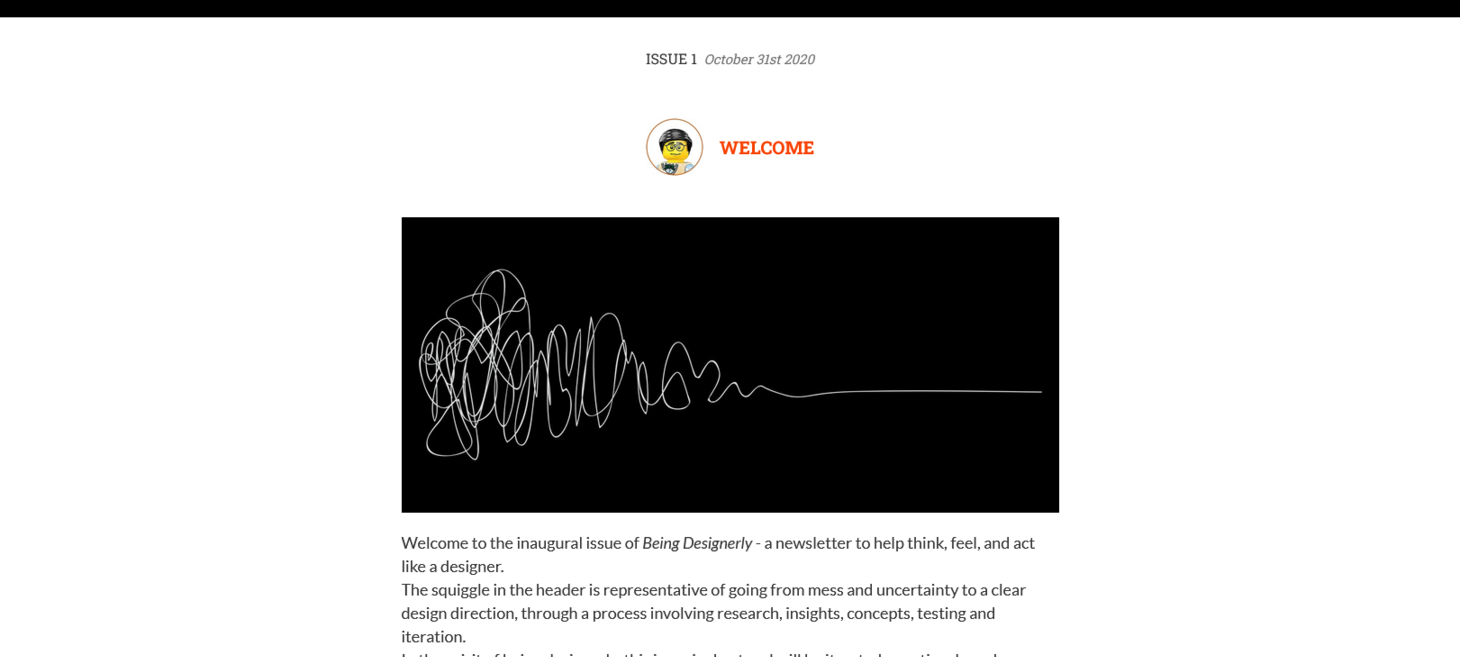
The first issue featured the design squiggle, a wonderful representation of the messy journey from uncertainty to clarity. I also promised to experiment, seek feedback, and iterate on the newsletter itself.
And for six years, that's largely what I've been doing.
From collecting dots to connecting them
I read a lot. Over the years, I shared hundreds of articles from design, psychology, technology, creativity, leadership, research, and occasionally unexpected places.
Every fortnight, I'd select seven to ten of the most relevant and interesting ones, with brief summaries or observations about why they were worth reading.
Looking back at the anniversary editions tells an interesting story.
The second-anniversary issue featured creativity, problem-solving, curiosity, empathy, accessibility, and design thinking. The third explored similar themes but also raised questions about technology's effects on human connection, including whether self-checkout kiosks might be making us lonelier.
By the fourth anniversary, AI-generated art had entered the discussion alongside feedback, collaboration, and human-centered design. Last year's fifth-anniversary roundup included AI-generated music, vibe coding, challenging beliefs with AI, and the enduring importance of empathy and inclusive design.
Along the way, I realized that while I was sometimes summarizing articles and sometimes offering my own perspective, I wasn't consistently connecting those ideas into something readers could apply.
So over the past year, I've been experimenting with a different approach: fewer articles, a more focused perspective, and a practical way to develop or exercise a capability in each issue.
Rather than just sharing interesting dots, I wanted to connect them.
But there was a bigger shift happening, too.
The skills haven't changed. The stakes have.
When I started Being Designerly, I was concerned about people learning to produce design deliverables without developing the thinking and behaviors behind them.
Today, AI can produce many of those deliverables, often faster and with an impressive level of polish. And it's not just design. AI can write, code, analyze, research, synthesize, and increasingly take action on our behalf.
Which raises a much bigger question.
If AI can do more of the things we once needed to learn to do ourselves, what happens to the capabilities we developed by doing them?
The concern is no longer limited to designers coming out of bootcamps. It applies to students, researchers, writers, leaders, developers, and anyone whose work involves thinking, creating, and making decisions.
We can become remarkably productive with AI while gradually exercising less of our own judgment. We might produce excellent-looking work without necessarily developing the understanding or capability behind it.
That's a risk I've been exploring through the idea of synthetic competence: when the quality of what we produce can mask a decline in what we're personally capable of understanding, evaluating, or doing.
This doesn't mean we should avoid AI or insist on doing everything ourselves. Far from it. AI creates extraordinary opportunities to extend our capabilities.
But it does mean being more deliberate about what we delegate and what we continue to practice.
That thinking led me to Undelegatable, an exploration of six human capabilities: Curiosity, Critical Judgment, Empathy, Advocacy, Orchestration, and Shaping.
Interestingly, many of these were present in the earliest issues of Being Designerly, long before I'd brought them together into a framework.
The difference is that I no longer see them primarily as designerly skills for designers.
They're human capabilities that matter to all of us. And as AI becomes more capable, our responsibility to exercise them becomes more important, not less.
THE YEAR'S MOST POPULAR READS
Since the second anniversary, I've periodically revisited the articles that attracted the most interest over the previous year.
Let's keep that tradition going.
Here are five of the most-clicked articles from the past year. If you missed any of them, here's another opportunity to explore them.
1. Agents, robots, and us: Skill partnerships in the age of AI
McKinsey Global Institute
This report examines how AI could transform work, including the activities that technology may increasingly automate and the changing skills people will need.
What interests me is the idea of skill partnerships. Instead of simply asking which jobs AI will replace, what if we focused on how people can become more capable by working with AI?
And just as importantly, which capabilities should we be careful not to lose along the way?
2. The $117 Trillion World Economy in One Giant Visualization
Visual Capitalist
A visualization of the world's economies that makes it easier to explore their relative size and scale.
I've always appreciated good visual communication. It can make complex information accessible and help us notice patterns and relationships that aren't immediately obvious.
But it also reminds us that visualization is more than making data look attractive. There's judgment involved in deciding what to show, how to show it, and what conclusions the data actually supports.
3. Phia, the buzzy AI shopping tool, was pulling far more user data than disclosed
Fortune
Security researchers discovered that an earlier version of an AI shopping browser extension was collecting substantially more information than users might have expected.
As AI tools become increasingly embedded in everyday experiences, the questions about transparency, consent, and trust become more consequential.
It's a reminder that designing something people want to use also comes with a responsibility to consider what they may unknowingly be giving up.
4. How AI Works and How Users Think About It: Study Guide
Nielsen Norman Group
A useful collection of resources examining AI capabilities and how people understand and interact with AI systems.
People form mental models based on what technology appears to do. When AI communicates fluently and confidently, it's easy to attribute more understanding or reliability to it than is warranted.
Understanding how people perceive AI is essential to creating experiences that help them make informed decisions rather than simply trust the output.
5. Designing for Older Audiences: Checklist + Best Practices
UX Collective
While so much attention is focused on what AI can do, this article brings us back to something fundamental: understanding the people we're designing for.
Different abilities, experiences, needs, and expectations require thoughtful design decisions. Inclusive design begins with noticing what we might otherwise overlook.
Technology will continue to evolve, but empathy, observation, and advocacy remain essential.
One more I'd recommend
The articles above earned their places through reader interest. But popularity isn't the only reason something is worth revisiting.
One recent issue I'm particularly pleased with is #154: Protect the Unfinished.
It explores how AI-generated work can look so polished that we're tempted to converge on a solution before adequately exploring the problem.
It's also representative of where I'm taking this newsletter: connecting research and ideas around a human capability, then offering something practical to try.
If you've ever looked at a polished AI-generated answer and thought, "That looks good enough," this one might make you reconsider.
LOOKING BACK, LOOKING AHEAD
Six years. 156 issues. One every fortnight.
Some issues practically wrote themselves. Others needed a little more persuasion, especially around vacations, celebrations, and everything else life throws at us. There were times I had to force myself to sit down, finish, and hit publish.
But I kept going.
And somewhere along the way, the process of reading, questioning, connecting ideas, and writing about them changed my own thinking, too.
What began as an effort to help newer designers develop their designerly skills has grown into a much broader exploration of what it means to remain capable, thoughtful, and human in an increasingly AI-augmented world.
Which brings me back to that squiggle from Issue #1.
The squiggle represents the messy journey of exploring a problem, questioning assumptions, finding insights, testing ideas, and eventually arriving at something meaningful.
AI makes it increasingly easy to skip ahead to something that resembles a finished answer.
But there's something valuable in that messy middle. It's where we develop understanding, judgment, curiosity, and confidence in our own abilities. Getting to the destination isn't always the same as growing through the journey.
I'm not suggesting we should make every task unnecessarily difficult or refuse help from AI. But we should be intentional about which parts of the journey contribute to our own development.
The goal isn't to protect tasks from AI. It's to protect and develop the human capabilities that matter, even as the tasks change.
That's what I want to keep exploring in Year 7.
 UNTIL NEXT TIME
Thank you for reading, sharing, challenging, and occasionally replying to these issues. Whether you've been here since #1 or joined somewhere along the way, I appreciate you being part of this ongoing experiment.
And I'd love to hear from you:
What's one human capability you're making a conscious effort to keep exercising, even though AI could do more of the work for you?
Hit reply and tell me. Your answers might help shape what we explore in Year 7.
Until next time,
Lyndon