

 FEATURE
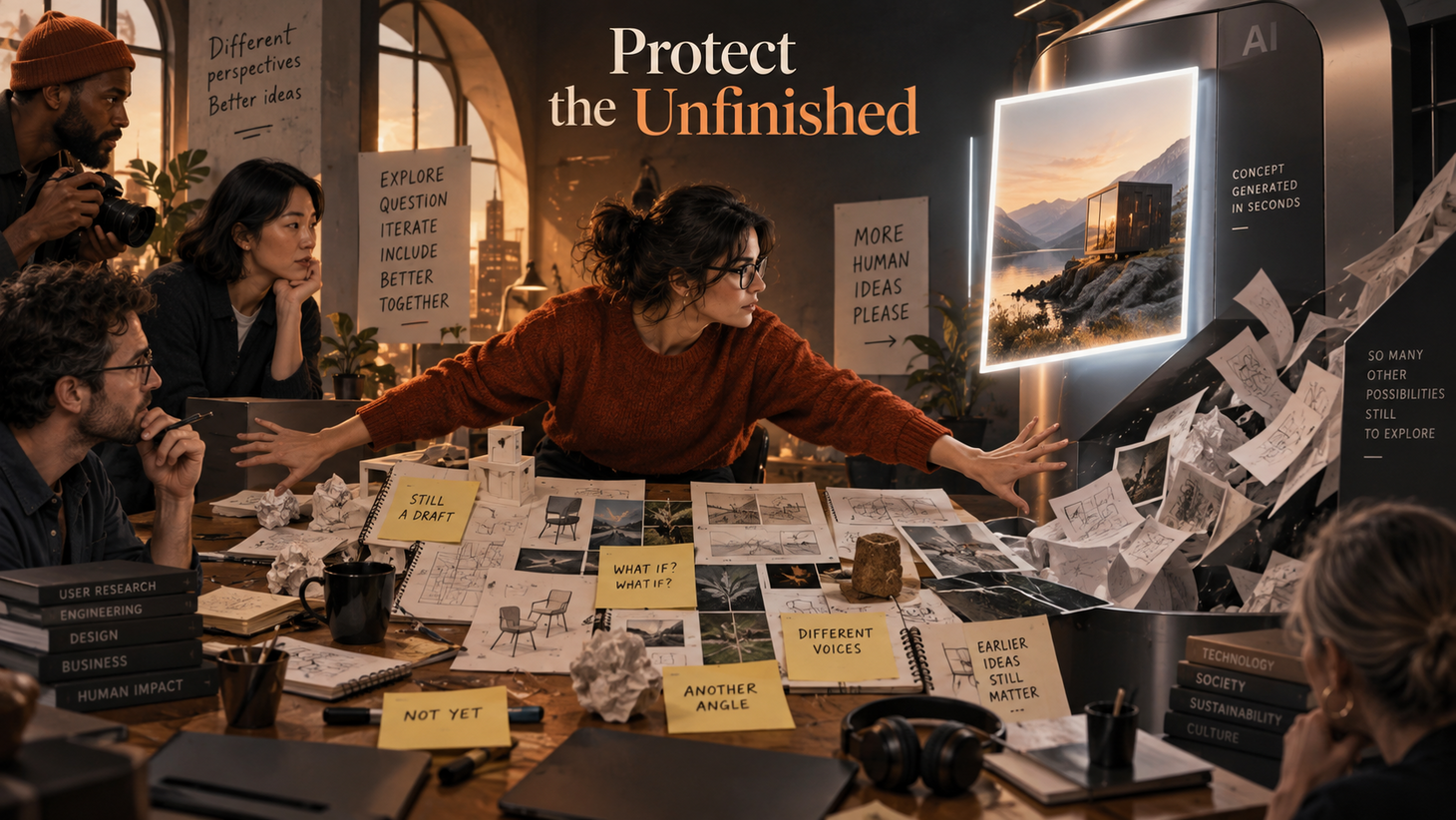
Protect the Unfinished
A photographer was reviewing an image for an advertising campaign. The client loved it. There was just one problem. A man in the image wore a baseball cap that cast his face in shadow, yet his eyes were brightly illuminated. To the photographer, the issue was obvious: the lighting was physically impossible.
The concept had been generated with AI. Now the production team had to figure out how to recreate something reality couldn't. That story comes from recent research into how generative AI is changing creative work. The researchers found that AI wasn't simply speeding up existing processes. It was compressing them. Brainstorming, developing, visualizing and refining ideas could suddenly happen almost simultaneously, often with fewer people involved.
The researchers call part of the resulting problem early aesthetic closure. I think that's a useful idea far beyond advertising. AI makes unfinished thinking look finished.
A rough sketch signals possibility.
A photorealistic rendering signals decision.
A page of messy notes invites questions.
A beautifully structured AI response arrives with headings, recommendations and a conclusion. Nothing about that presentation guarantees the thinking underneath it is complete. But polish changes how we respond to it. We stop asking What else? and start asking How do we execute this?
Think of it as Premature Closure: When AI Finishes Before You’re Ready
Faster isn't always further
Another recent study looked at something seemingly different: algorithms used for search and discovery. Most are optimized to give us relevant information efficiently. That's usually a feature. But creativity has a strange relationship with relevance. Researchers found that tools deliberately designed to expose people to less common, more diverse information helped them explore more distinct solution spaces than conventional relevance-oriented algorithms. Most interestingly, experts benefited substantially from that exploration.
Expertise wasn't especially powerful when everyone was being shown similar, familiar information. Give experts unfamiliar dots, though, and they became better at connecting them.
That made me rethink one of the most common ways we use AI. We ask:
What's the best way to…?
Give me the top five…
Summarize the options…
What do you recommend?
Those are convergence questions. Useful ones. But if we ask them too early, we're using an extraordinary exploration technology primarily to help us stop exploring.
Curiosity isn't just the ability to ask questions. It's the ability to remain in the question after a plausible answer appears.
Some things have to emerge
The third piece that caught my attention wasn't specifically about generative AI. Researchers followed ten European manufacturers introducing new technologies over three years. Like many organizations, these companies tried to anticipate which new capabilities employees would need. But some of the most useful skills weren't the ones that had been predicted. They emerged as people actually encountered the technology. Workers improvised. They developed workarounds. They combined old expertise with new tools in ways nobody had planned. And effective managers learned to notice those behaviors and turn them into capabilities the wider organization could develop.
There's an important lesson hiding there.
We're spending enormous energy trying to define the skills humans will need in an AI world. I spend a lot of time thinking and writing about them. Maybe some of them aren't definable yet. They have to be discovered through the work. Which means leaders need more than foresight. They need curiosity to notice something they weren't looking for and orchestration to connect the people and conditions that allow it to spread.
Expand before you collapse
I'm not making an argument for slower work. There is plenty of work AI should compress mercilessly. Formatting a document isn't improved by making it take an hour.
But exploration and execution aren't the same kind of work. When we're executing, compression can be incredibly valuable. When we're still trying to understand the problem, discover possibilities or learn what people are capable of, premature compression can erase the very things we're trying to find.
So perhaps the question isn't: How much faster can AI get me to an answer?
It's: Have I explored enough to deserve an answer yet?
AI can help us expand a possibility space faster than we ever could before. Generate alternatives. Introduce unfamiliar perspectives. Prototype ideas. Challenge assumptions. Connect disciplines.
Then it can help us converge. The sequence matters.
Expand before you collapse.
Sometimes the most undelegatable thing we can do is recognize that something which looks finished still needs to remain unfinished a little longer.
THE TELL
You may be closing too early when:
- Your first interaction with AI is asking for a recommendation rather than possibilities.
- The team starts debating details of a polished concept before questioning the concept itself.
- Everyone is reacting to the same research, examples or AI-generated options.
- A prototype has become persuasive enough that people stop asking what assumptions it contains.
- You ask AI to improve its first answer rather than help you escape it.
The tell isn't that AI produced something bad.
It's that it produced something good enough to stop the conversation.
YOUR PRACTICE THIS FORTNIGHT
Keep three doors open
The next time AI gives you an answer you like, don't refine it immediately.
Keep three doors open first:
1. Another possibility “What is a meaningfully different approach - not a variation of this one?”
2. Another perspective “Who would see this problem differently, and what might they notice that I won't?”
3. Another domain “Where has a completely different field solved a structurally similar problem?”
Then decide whether your original direction still deserves to win. This isn't about generating 50 options. It's about preventing the first plausible one from becoming inevitable.
SPARRING PROMPT
Use AI to expand before you converge:
I have a direction that currently seems promising. Don't improve it yet.
First, help me determine whether I'm converging too soon.
- Identify the assumptions making this direction feel obvious.
- Give me three genuinely different ways to frame the underlying problem.
- Introduce one relevant perspective from outside my field.
- Identify what additional evidence or expertise could materially change my mind.
- Only then compare the original direction with the alternatives.
Your job is not to make my current idea better. Your job is to make sure it has earned the right to survive.
ARTICLES
Research: Gen AI Is Collapsing Creative Processes - Harvard Business Review
A yearlong study of senior creatives found that generative AI can compress stages of creative work that previously involved different people and different forms of expertise. Polished outputs can create early aesthetic closure - making ideas feel decided before downstream experts have pressure-tested whether they can actually be produced. The useful takeaway isn't “slow AI down.” It's to preserve options and involve expertise before polish turns possibility into commitment.
Algorithms Trap Us in the Familiar. Can They Also Spark Breakthroughs? - MIT Sloan Management Review
Algorithms optimized for relevance tend to surface familiar information. Research comparing that approach with exploration-oriented tools found that deliberately exposing people to diverse, uncommon information opened new solution spaces, and allowed domain expertise to contribute more strongly. Efficiency helps us find what we're looking for. Curiosity sometimes depends on finding what we weren't looking for.
Spot New Tech Skills Emerging From the Workforce - MIT Sloan Management Review
After studying ten European manufacturers over three years, researchers found that important capabilities required by new technology often emerged organically as workers adapted it rather than appearing in advance skill forecasts. Their implication for leaders: don't only prescribe skills. Watch closely enough to notice new ones being invented in the work.
ONE THING TO TRY
The next time someone (including AI) shows you something surprisingly polished early in a project, resist saying: “Looks good.”
Ask: “What are we treating as decided because this looks more finished than it really is?”
Avoid Premature Closure - don't let AI finish before you're ready.

 UNTIL NEXT TIME
AI gives us an unprecedented ability to move from ambiguity to something tangible. That's mostly a gift. But ambiguity has a job too. It's where alternatives survive long enough to be considered, expertise finds unexpected connections, and capabilities we didn't know to look for have room to emerge.
I'm curious: Where in your work is a little unfinishedness actually useful?
Hit reply. I'd love to hear where you've learned not to converge too quickly.
Until next time, Lyndon
Think first, then consult.