
 WELCOME
When AI makes you sound better - and seem worse
The closer a message gets to trust, care, or accountability, the more of you may need to remain in it.
AI can make a workplace message clearer, smoother, and more professional. It can also make the person sending it seem less sincere, less caring, and less trustworthy. That tension keeps showing up in research on AI-mediated communication. The question isn’t whether we should use AI to write. It’s what we’re actually delegating when we do. Because sometimes the words are carrying information. Sometimes they’re carrying you.

 FEATURE
The message can be delegated. The relationship can’t.
A meeting reminder written by AI probably doesn’t bother you. An apology might. That difference matters.
Research on AI-assisted workplace writing suggests something counterintuitive: The message can improve while perceptions of the person behind it get worse.
In one study, people generally considered AI-assisted messages from a manager professional. But as AI assistance increased, they became more likely to question the manager’s sincerity, caring, confidence, communication ability, and authorship.
Research on apologies points in the same direction. Extensive AI assistance made an apology seem less authentic and reduced willingness to forgive.
But limited support, such as translation or language correction, didn’t have the same effect. That distinction feels important. People may be comfortable when AI helps us express what we mean, but they become less comfortable when it appears to supply the meaning for us.
Another study adds a wrinkle: when AI use was explicitly disclosed, people judged communicators more negatively. When potential AI use wasn’t highlighted, much of that penalty disappeared.
So this isn’t simply: AI writing = inauthentic.
Writing carries two things at once: The content of the message AND a signal about the person sending it.
Specific praise signals attention. A thoughtful apology signals effort. Difficult feedback signals responsibility.
A supportive note says, in part: I spent some of my attention on you.
AI can improve the words while changing that second signal, which means we need more than rules about when AI is allowed. We need judgment about relational weight.
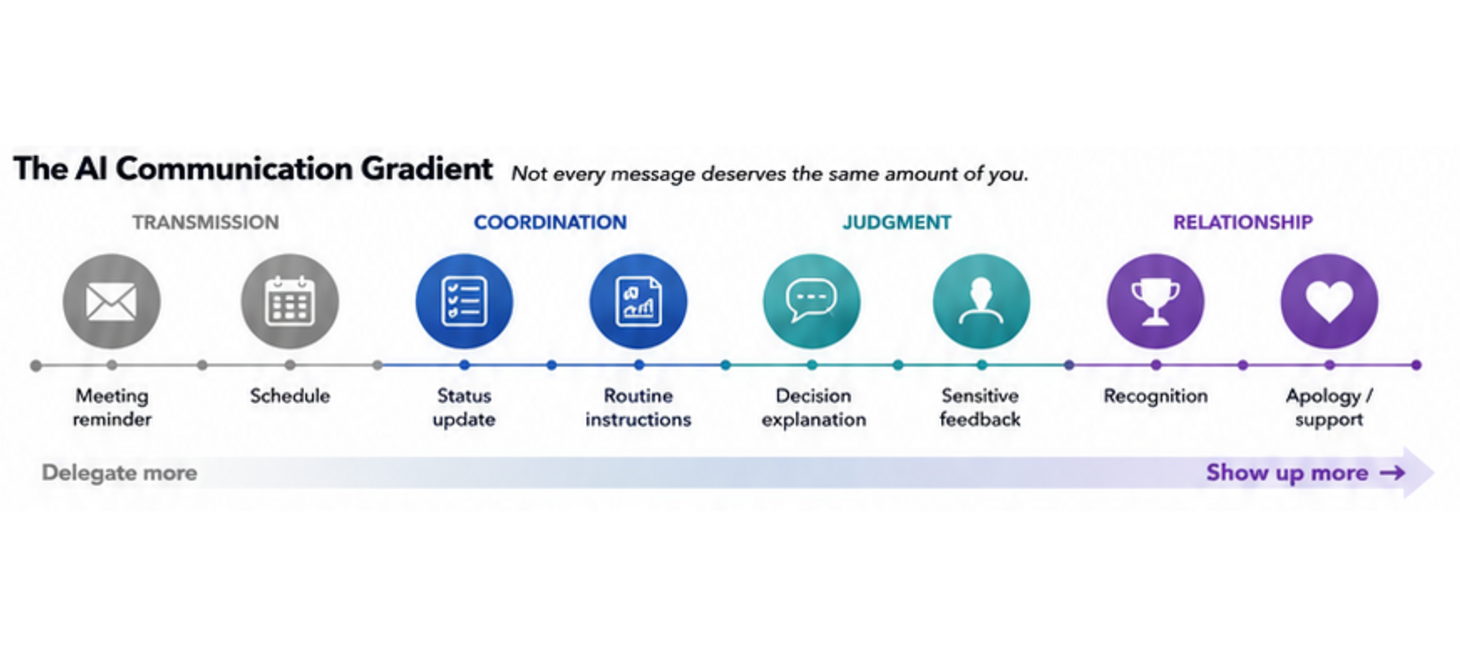
The AI Communication Gradient
Not every message deserves the same amount of you. At the transmission end, the main job is moving accurate information. As you move toward relationship, the message starts carrying more - intent, judgment, care, accountability, knowledge of the other person
AI can still help anywhere on the spectrum - with structure, clarity, translation, tone, or critique. The question is how much authorship you hand over. The closer a message gets to trust, care, accountability, or identity, the more human involvement becomes part of the message. That’s where two undelegatable skills work together.
Empathy: What does this person need from me - not just from these words?
Critical Judgment: How much of this interaction should remain mine?
THE TELL
AI may be doing more than helping with your wording when:
- You care more about whether the message sounds polished than whether it sounds like you.
- Praise becomes smoother but less specific.
- You ask AI to formulate an apology before deciding what you actually regret.
- You delegate difficult feedback partly because writing it feels uncomfortable.
- You use emotional language you wouldn’t naturally use yourself.
- You’d hesitate to tell the recipient how much AI contributed.
That last one is important: If disclosure would change the meaning of the message, AI may not be merely helping with the wording. You may be delegating part of the signal.
YOUR PRACTICE THIS FORTNIGHT
🛠 The Relational Weight Test
Before using AI on an important message, ask:
TRUST: Could this change how the recipient trusts me?
CARE: Is my attention or personal effort part of what I’m trying to communicate?
ACCOUNTABILITY: Do I need to visibly own what is being said?
Then count the yeses.
0: Delegate freely. Let AI draft, organize, summarize, or polish.
1: Assist, but stay involved. Give AI your intent and context rather than asking it to invent them.
2–3: Write the human core yourself. Then use AI to critique, clarify, translate, or pressure-test it.
Before prompting, write down:
- What do I actually mean?
- What do I need to own?
- What is specific to this person or situation?
- What should unmistakably sound like me?
The point isn’t to prove you can write without assistance. It’s to know which part you’re unwilling to outsource.
🤖 THE SPARRING PROMPT
Help me think. Don’t write it for me.
I need to communicate something important to another person.
Do not write the message for me.
Help me think through:
- What the recipient may need from me.
- What I need to take responsibility for.
- What could sound generic, evasive, performative, or insincere.
- What specific knowledge of this person or situation belongs in the message.
- What I may be avoiding because the conversation is uncomfortable.
Ask me one question at a time.
After I draft the message, critique it for clarity, empathy, specificity, ownership, and likely interpretation.
Do not rewrite it unless I explicitly ask you to.
There’s an important difference between:
“Write the difficult message for me.”
and
“Help me understand what this difficult message requires from me.”
One delegates the capability; the other exercises it.
THE PROOF
📄 Professionalism and Trustworthiness in AI-Assisted Workplace Writing
Cardon and Coman found that people could view AI-assisted workplace writing as professional while becoming more skeptical of the manager behind it as AI assistance increased. Why it matters: Message quality and sender credibility are not the same variable.
📄 AI-Mediated Apology in a Multilingual Work Context
Glikson and Asscher found that extensive AI mediation reduced an apology’s perceived authenticity and willingness to forgive. Limited assistance didn’t produce the same penalty. Why it matters: Helping someone communicate their intent is different from replacing the effort behind it.
📄 Blissful (A)Ignorance
Zhu and Molnar found that negative impressions increased when AI use was explicitly disclosed, while potential AI use alone created little spontaneous suspicion. Why it matters: The social cost depends partly on what recipients believe about how the message was produced.
ONE THING TO TRY
Before your next piece of praise, apology, sensitive feedback, or support: Write the first three sentences yourself before opening AI.
Not because AI can’t write them. Because doing so forces you to decide what you mean before the machine makes it sound good. Then ask: Am I using AI to express what I mean - or to avoid doing the work of meaning it?
 UNTIL NEXT TIME
I’m curious where your line is: What workplace message would you never fully delegate to AI?
Hit reply. I’d love to hear where you think the human effort is part of the message.
And if this made you think of someone who uses AI for everything from meeting notes to heartfelt congratulations, forward it to them.
Until next time, Lyndon
Think first, then consult.